Rocket League vs FIFA Esports: Which Football-Themed Game Reigns Supreme?
Rocket League Esports
Pros
- ✓Unique hybrid gameplay combining soccer with vehicle physics
- ✓Faster-paced action with continuous momentum
- ✓Higher skill ceiling due to aerial mechanics and car control
- ✓Strong spectator appeal with spectacular goals and saves
- ✓Consistent competitive structure since 2016 with RLCS
Cons
- ✗Less accessible for casual players due to mechanical complexity
- ✗Requires more practice to reach competitive level
- ✗Car customization can create visual distractions
- ✗Physics-based gameplay can feel less realistic than traditional soccer
- ✗Limited team sizes (3v3) compared to traditional sports
FIFA Esports
Pros
- ✓Authentic soccer simulation with realistic player movements
- ✓Larger player base due to mainstream appeal
- ✓Team-based strategies mirror real football tactics
- ✓Multiple competitive formats (1v1, 2v2, 3v3, 11v11)
- ✓Stronger connection to traditional football culture
Cons
- ✗More dependent on game mechanics and AI behavior
- ✗Can feel slower-paced with more tactical buildup
- ✗Higher RNG elements affecting match outcomes
- ✗More prone to defensive, time-wasting strategies
- ✗Annual releases can disrupt competitive continuity
Rocket League vs FIFA Esports: A Comprehensive Comparison
When it comes to football-themed esports, two games dominate the landscape: Rocket League and FIFA. Both offer unique competitive experiences but appeal to different audiences and skill sets. Let's dive deep into what makes each game special and how they stack up against each other.
Gameplay Mechanics and Core Differences
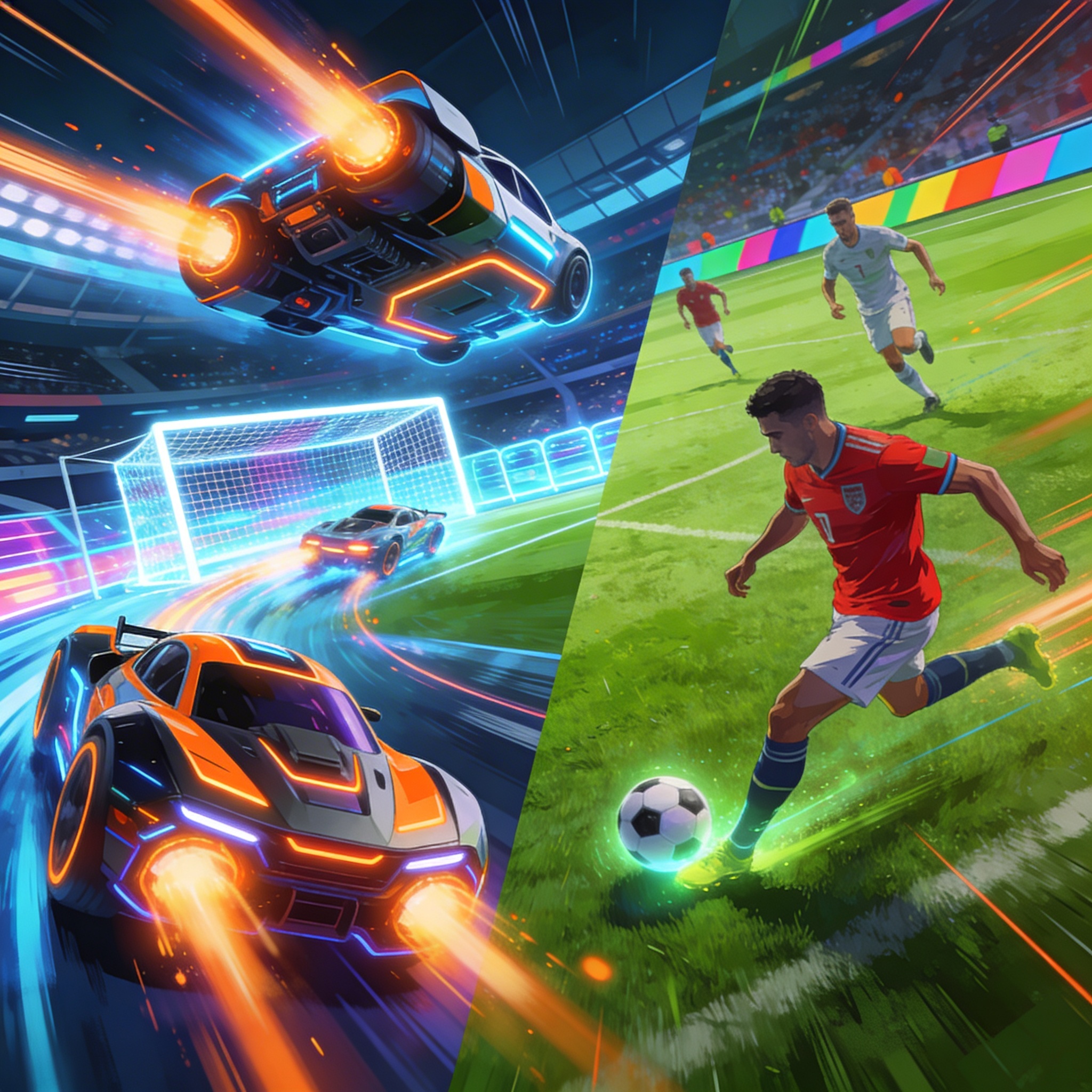
Rocket League is essentially soccer played with rocket-powered cars. This unique twist creates a completely different competitive experience compared to traditional soccer games. The physics-based gameplay means every touch, jump, and boost requires precise timing and spatial awareness. Players must master aerial maneuvers, car control, and team coordination while navigating a 3v3 format.
FIFA Esports, on the other hand, offers a realistic soccer simulation. Players control human athletes with authentic movements, tactics, and strategies that mirror real-world football. The gameplay emphasizes passing, positioning, and tactical awareness, with competitive formats ranging from 1v1 duels to full 11v11 matches.
Competitive Scene and Professional Structure
Rocket League has built a strong competitive foundation through the Rocket League Championship Series (RLCS), which has been running since 2016. The game features consistent updates, a dedicated competitive mode, and a thriving professional scene with teams like NRG, G2, and Team Vitality. The 3v3 format creates tight-knit team dynamics and allows for spectacular individual plays.
FIFA Esports operates under the FIFAe banner, featuring multiple tournament formats and a longer competitive history dating back to the early 2000s. The FIFAe World Cup and other major tournaments attract massive audiences, particularly in regions with strong football traditions. However, the annual release cycle can disrupt competitive continuity.
Skill Requirements and Learning Curve
Rocket League demands exceptional mechanical skills. Players must master:
- Aerial control and aerial shots
- Car positioning and boost management
- Rotation systems and team play
- Quick decision-making under pressure
The learning curve is steep, but the game rewards dedication with a high skill ceiling that keeps players engaged for years.
FIFA requires different skills:
- Tactical understanding of formations and strategies
- Passing accuracy and timing
- Defensive positioning
- Game management and clock awareness
While more accessible initially, FIFA's competitive scene involves mastering complex mechanics and understanding meta strategies that evolve with each annual release.
Spectator Experience
Rocket League offers incredible viewing experiences with:
- Spectacular aerial goals and saves
- Fast-paced, non-stop action
- Clear visual understanding of plays
- Exciting momentum shifts
FIFA provides a more traditional sports viewing experience:
- Realistic player movements and animations
- Tactical battles and strategic depth
- Familiar soccer commentary and presentation
- Connection to real-world football culture
Community and Cultural Impact
Rocket League has cultivated a passionate community around its unique gameplay. The game's accessibility across platforms and free-to-play model has helped it grow steadily. Its esports scene attracts viewers who appreciate the skill and creativity involved in car-based soccer.
FIFA benefits from its connection to the world's most popular sport. The game has massive mainstream appeal, with FIFAe tournaments drawing viewers who might not typically watch esports. The integration with real football clubs and players creates a bridge between traditional sports and competitive gaming.
Recent Developments and Future Outlook
Both games have evolved significantly. Rocket League continues to refine its competitive ecosystem with improved spectator tools and consistent updates. The game's inclusion in the FIFAe Finals 2025 alongside traditional FIFA titles demonstrates its growing legitimacy in football esports.
FIFA Esports has adapted to changing player preferences and competitive demands. The introduction of new formats and the integration with the broader FIFAe ecosystem shows the game's commitment to evolving with the esports landscape.
Which One is Better for Esports?
The answer depends on what you value in competitive gaming:
Choose Rocket League if you prefer:
- High mechanical skill requirements
- Fast-paced, action-packed gameplay
- Unique visual spectacle
- Consistent competitive structure
Choose FIFA if you prefer:
- Authentic soccer simulation
- Tactical depth and strategy
- Connection to traditional football
- Multiple competitive formats
Both games offer legitimate competitive experiences and have their place in the esports ecosystem. Rocket League's mechanical complexity and consistent updates have created a dedicated competitive scene, while FIFA's mainstream appeal and authentic soccer simulation continue to attract massive audiences.
Rather than declaring one definitively better, it's more accurate to say they serve different niches within football esports. Rocket League offers a unique, skill-intensive experience that stands apart from traditional soccer, while FIFA provides the authentic soccer experience that millions of football fans crave in competitive form.
The future of football esports likely includes both games continuing to thrive, each appealing to different segments of the gaming and sports communities.
Feature Comparison
| Feature | Rocket League Esports | FIFA Esports |
|---|---|---|
| Gameplay Style | Vehicle-based hybrid | Traditional soccer simulation |
| Skill Ceiling | Very high (aerial mechanics) | Moderate (tactical execution) |
| Team Size | 3v3 standard | 1v1 to 11v11 formats |
| Learning Curve | Steep for beginners | Moderate, more intuitive |
| Spectator Appeal | High (spectacular plays) | Moderate (tactical depth) |
| Competitive History | RLCS since 2016 | FIFAe World Cup since 2004 |
| Realism | Arcade-style physics | Authentic soccer simulation |
| Global Reach | Strong but niche | Massive mainstream audience |
Verdict
Final Verdict: Two Champions in Different Divisions
After extensive analysis, it's clear that Rocket League and FIFA Esports are both champions in their own right, but they compete in different divisions of the football gaming world.
Rocket League emerges as the superior competitive game from a pure esports perspective. Its consistent competitive structure, high skill ceiling, and spectacular gameplay make it incredibly engaging for both players and viewers. The mechanical complexity and team coordination required create a legitimate esport that rewards dedication and skill. If you're looking for the most competitive, skill-intensive football-themed game, Rocket League is the clear winner.
FIFA Esports dominates in terms of mainstream appeal and cultural impact. Its authentic soccer simulation, connection to real football, and massive player base make it the more accessible and widely recognized option. For players who want to experience competitive soccer gaming with familiar rules and tactics, FIFA remains unmatched.
The recent inclusion of Rocket League in FIFAe Finals alongside traditional FIFA titles suggests a future where both games coexist and complement each other in the football esports ecosystem. Rather than competing directly, they serve different audiences and preferences within the broader football gaming community.
Our recommendation: If you're primarily interested in competitive gaming and esports, Rocket League offers the more rewarding competitive experience. If you're a traditional football fan looking to engage with competitive gaming, FIFA provides the most authentic connection to the sport. The best choice depends entirely on your personal preferences and what you value most in competitive gaming.
Last updated: March 12, 2026